a prelude to kicking your ass
letter from the editor
Hey, donkeys.
No sugarcoating it. 2025 was a terrible year. But we’ve survived, which is something. Our survival is crucial. Even beaten down, even with our asses kicked, we manage to go on. Should we go on? I don’t know, but we do. We don’t know how we do it, but we do it. And we keep doing it. We keep trying and that’s enough.
That’s kind of the essence of kicking your ass. That’s why I’m putting out a third issue of this thing: to show that when facing the worst of times, we have to go on making art. Yes, even poetry. Poetry is art. Don’t you forget that. And if you did forget, go read this issue. It’ll make you remember.
– adrian
poems
jo gatford
UNREALISTIC EXPECTATIONS
don’t ask me
to thrive
in a fast-paced
environment
I see you
and I raise you
absolutely
nothing
braless and
unbothered
body
doubling
the void
Jo Gatford is a short writer who writes (mostly) short things. Her work has been selected for Best Small Fictions, Best Microfictions and Wigleaf Top 50, and her chapbook The Woman’s Part was published by Stanchion Books. Find her chasing glimmers at The Joy of Fixion (fixioning.substack.com), read more of her writing at jogatford.com, or say hi on various socials @jmgatford
tara labovich
The Shaman Of Girl Cowboys
i met her more than once, often dripping in caverns
and howling ravines. she said her prayers with a twang
i could never place. the Shaman of Girl Cowboys
did not just sing in red canyons, but anywhere
a horse could manage to get herself. she played a loose
string guitar built from coffee cans and tail hair. she
told stories from the bottoms of her feet. she wrote
her own lullabies, of campfires with the best goss
and summer ghouls summoned through sweat and skin.
she refused talk of gender essentialism, but still said
i could ride a horse best if i had a cunt. that way, she said,
the wind has an extra door to enter the body.
after all, she said, horses are animals of wind.
it’s simple addition, she said. sure, some cunts are longer
than others. and there are many doors to let the wind in.
you can drive fast on a narrow mountain
road, eat two cans of beans
in one sitting, name a star
after a lover’s sweating hand—
and in that act
open wide
the wet unlit grotto
of the heart.
Tara Labovich (they/them, MFA) is a writer and lecturer of English and Creative Writing in Iowa. Their multi-genre creative work explores questions of queerness, survivorship, and multicultural upbringing. Their writing is nominated for Best of the Net, and can be found in journals such as Salt Hill and the Citron Review.
ben niespodziany
INFOMERCIAL
If you’re up watching this, the host says, these knives symbolize America and with them, so will you. One husband asks to use the phone. He needs these knives. But his wife is already on the line, giving away her social to an older more well-known mode. America is a sword without a handle. A man on fire trying to make rent.
Benjamin Niespodziany is a Chicago-based writer whose work has appeared in Indiana Review, Fence, Booth, Conduit, Bennington Review, and elsewhere. His writing has been featured in the Wigleaf Top 50 and has been nominated for the Pushcart Prize, Best Microfiction, and Best of the Net. The host of a bi-monthly reading series known as Neon Night Mic, he also recently launched his own indie press known as Piżama Press.
rowan tate
I LEFT THE LIGHT ON
I don’t recall turning the switch
but the room glowed all night
like it knew something I didn’t. I
must’ve walked past it—maybe
twice—maybe not at all. Hard to say.
There was a sound. Could’ve been
a door or the fridge settling. Could’ve
been me. I remember thinking
someone should do something
about the buzz in the walls.
That someone might’ve been me.
I did write a note, or dream I did.
Something about eyes or forgetting.
It’s unclear. These days feel
like old film reels spliced out
of order. If I spoke to you,
I hope I was kind. If I didn’t,
I hope you understand.
Rowan Tate is a creative and curator of beauty. She reads nonfiction nature books, the backs of shampoo bottles, and sometimes minds.
literary beatdown
bob sykora
This time, kicking your ass welcomes to the literary beatdown Bob Sykora, the author of Utopians in Love, a book he wrote that I’ve read a several times. Gaze upon its cover:
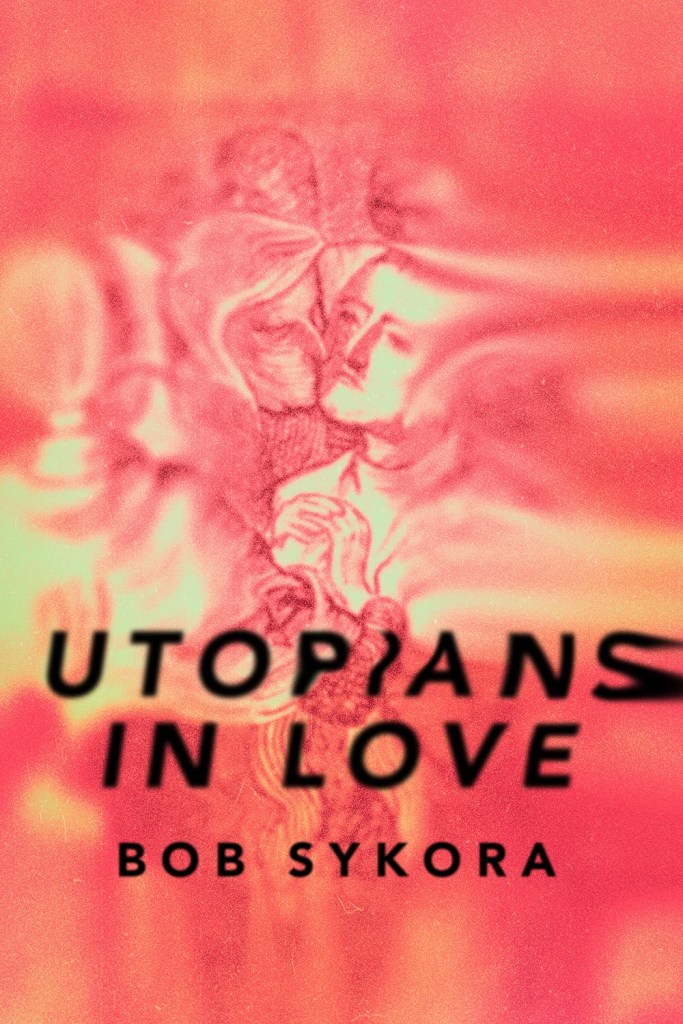
We talked about his book, poetry, feelings, failure and Boston, which is a city you may know from such books as Utopians in Love by Bob Sykora.
KYA: What is the deal with Bob Sykora and Boston?
BOB SYKORA: I mean have you ever been to Boston!? It’s our country’s premiere bad city. Like all good or at least interesting things, it’s littered with contradictions. I spent almost every minute I lived in Boston (side note, I actually lived across the river in Somerville as I could neither afford nor desired to live in the city proper) comparing it to Chicago, and Chicago handily won every single comparison. But the second I left Boston, I immediately missed it. I don’t know if I can say that I definitively love or hate Boston, but I do feel deeply about it. And I felt a lot of things deeply while I was there. If nothing else, it’s an incredible city to walk through and feel any feeling deeply.
What’s your most Boston story?
I mean, I met Keytar Bear one time.
Several of the poems in the book speak to an unnamed you, who I assume is either Keytar Bear or a beloved from a relationship gone wrong. What made you want to be so public about your failure as a lover?
Wait, are you telling me poetry doesn’t have to be about longing, intimacy, and failure? Are you sure?
What drew you to utopias and what hole were you trying to fill?
Picture this: It’s late February, maybe early March 2016. (Remember 2016? Woof.) I’m sitting in the rare books room of the Boston Public Library doing research for a class focused on the slippery definition of “lyric poetry.”
Sounds hot.
(Your eyes are already glazing over, but stay with me) At the time, the rare books room hadn’t digitized their collection, so I’m picking through the old school card catalog. I come across a card that says “Brook Farm. American Utopia.” The words “American” and “Utopia” don’t make any sense next to each other. They still don’t. I stay up all night reading about 19th century American utopian communities. I don’t know if I ever finished the assignment I’d originally gone to the library for. The next morning, and every day since, everything is the same but also markedly changed.
Now tell me about the hole!
The hole I was trying to fill was probably similar to the one described in CK Williams’ “The Critic,” which is probably the best poem about the Boston Public Library and, unfortunately, only exists online in the archive for Garrison Keiller’s Writer’s Almanac.
You’re going to make me think about Garrison Keiller?
Sorry.
What does it say about the Americans that they continue to believe they can build a perfect society when every attempt fails?
Not just believing, but trying! The trying is the point! The failing is the point! I wish there was more trying.
Trying and failing. Sounds like poetry to me.
Failure is so freeing! Like, I want to write into some sort of utopian poetics, but a genuinely utopian poetry will always be past the horizon beyond my reach. It’s always doomed. But even a glimpse makes it worth doing, right?
Is it? Everyone seems pretty depressed.
There is no perfect society. That’s not the point. Every day I wake up and the coffeemaker and the coffee and the raisin bran and the podcasts and the freeway and the traffic and the gas station and the long hours and the short ones and the websites and the bank accounts and the mail advertisements and the emails and the popups and the subscription service to all this and the so on so on so on all keep telling me to stop trying. The trying is the point!
Is poetry utopian?
Man, no one wanted to publish my essay on utopian poetics! It’s just sitting there, waiting. But fragments of it can be found here.
What is it you’re chasing when you’re writing a poem?
I think I’m chasing understanding? Both understanding myself and hoping to be understood by others. Like one of the reasons I turn to poems is to work through all the feelings and ideas that don’t really make sense anywhere else for me, the things I can’t quite communicate clearly even for myself. And poems feel like one of the only places where I can get really close to communicating things the way I actually want to. I feel so often we’re all missing each other with meaning. I’m so bad at actually saying what I want to in the moment. Poems let me really work at figuring out what the hell I actually want to say and finding a way to turn it into something.
Speaking of feelings. I’ve heard that you’ve said that it’s okay for poems to have feelings. Can you elaborate?
I have no idea what you’re specifically referring to, but it does sound like something I’d say.
I mean, let’s pretend you did say it.
I love feeling feelings. I just want to sit around and talk about feelings. Maybe what you’re thinking of—I feel like I’ve repeatedly expressed gratitude that I never had the kind of prescriptive poetry teacher who said something like I shouldn’t explicitly use a word like LOVE in my poems. I would be lost if I couldn’t write the word love whenever I wanted to.
What’s your least favorite poem in your book? What was challenging about it?
So part of my “research” for the book was visiting the historical sites of these failed utopian communities. And at the very first stop, a poem came to me really quickly, so I made the decision to include a series of “Visiting Utopia” poems for each of these sites, which quickly became a structural device that helped me organize the book. But when I visited the Oneida Community Mansion House, I had this really surreal, weird 24 hours that immediately felt like they should be poem fodder, but I never really sorted it out. So I have draft after draft of this poem “Visiting Utopia #4,” and they have much of the same language but they all look really different. And I was writing this one so late in the process that I felt committed to the series of “Visiting” poems to organize the book. It was the only poem that I felt forced to finish. Many, many other poems were easy to cast aside, but that one had to exist, and it was always felt like a mess to me. The second the poem began feeling like a box it felt impossible to write.
How do you know when a poem is working?
When I surprise myself. A poem is working when I can’t remember how or why I wrote the thing I did, but now that it’s written that way I’d be devastated to lose it.
Is utopia still on your mind or has the work moved past it? And what has your latest work looking to?
I so so so thought I’d be over utopia after 9 years of writing into it, but nope. I haven’t moved on. Still obsessed. My new stuff definitely isn’t so interested in history, but I’m still always trying to write something about time.
Last question. Robert Frost. Mary Oliver. These are just two poets who have written poems about blueberries. Now there’s Bob Sykora. What made you think you belonged in this league?
To be honest I was just warming up for blackberries. Seamus Heaney, Galway Kinnell, Yosuf Komunyakka, Margarte Atwood, Emily Dickinson–they all wrote about blackberries. Blackberries are next.
Purchase a copy of Utopians in Love here.
Bob Sykora is the author of the chapbook I Was Talking About Love–You Are Talking About Geography (Nostrovia! 2016) and the microchap Various Other Utopias (Ghost City Press 2022). A graduate of the UMass Boston MFA program, he lives in Kansas City where teaches at community college, edits with Garden Party Collective, co-hosts The Line Break podcast, and curates the KC Poetry Calendar. He can be found online @bob_sykora_ and bobsykora.com.
 kicking your ass