a prelude to kicking your ass
letter from the editor
Hey, donkeys.
It’s here! The historically unprecedented second issue of kicking your ass. It’s been a while. I know. We all fall behind our goals, especially when that goal is historically unprecedented, like this, the historically unprecedented second issue of kicking your ass. We meant to have this out in January, I think. I can’t remember that far back, which means I can’t give you an excuse. Which means there is no excuse and this is how I wanted it to happen all along.
We have five kick ass poems for you this time around, all about eating and consumption, because that was the theme of this issue. “There was a theme?” you might be asking. Don’t worry about it. The poems are the important part, so go read those.
Also for this issue, we got Kat Giordano to enter the Thunderdome to discuss their great new poetry collection Thumbsucker, published by Malarkey Books. Be a good little cherub and buy yourself a copy while you still can. Time is running out. We could die any day now. What are you waiting for?
Well?
– adrian
poems
casey garfield
post viral illness is kicking my ass and now god and the devil are raging inside me
all i reinvent is religion
i am learning to worship myself
i do a lot of deep breathing
i eat a lot of antioxidants
and i still feel anxious
like how the gatorade i chased
with a monster energy
leaves my body unsure
if she’s being hydrated
i go on a lot of slow mental health walks
through the cemetery
i go on a lot of long physical health rests
on the cemetery bench
i spend a lot of time staring at the cemetery
watching blackberries grow from the graves
i lean into grazing
risking thorns and hauntings
just to mark myself with the juice
on the days (most days
this month) i am not well enough to walk
i sit in the garden instead
imagine the berries that might stain my skin
when my hands betray me
when my cup falls more than i’d like
i get to practice forgiveness again
i dirty my face in meaningful ways
to give the water something to wash off me
Casey Garfield is a poet, publisher and pal currently working on being the happiest they’ve ever been. Their introductory mini-collection, ‘hi hello I love you my name is Casey Garfield’, will be available for free from Ghost City Press this summer, and more of their work can be found on instagram @thepoetnotthecat
noll griffin
PUT OFF
The exhibit about lungs at the defunct health museum
Reeked of cold french fry worms smashed at a greasy bag bottom,
Between posters of charred tissue and rubber prop organs
Saying hey, look how your father is going to die someday
And I gagged.
The foam blocks forming human hearts gave a rigid grin of dust-clogged cracks,
Holding a cute tray of outdated phobia pamphlets.
The volunteers smoking at the door didn’t flinch,
Just waved the bloated breeze of salt and mildew backwards, inside.
Some sort of trick question stuck, I figured on purpose.
Would I still get a kids’ meal on the way home,
Nostrils twisted by fast food in formaldehyde?
I did but it’s been lost in my sinuses ever since,
Dreams of antique brown dessert cases unlocked with a fork
That disintegrate into foul fire alarms in my mouth.
When I realize I’m asleep, I wish for anything
With a quieter taste.
Noll Griffin is a visual artist, writer, and musician based in Berlin, Germany. His poetry has appeared in The Purposeful Mayonnaise, The Wild Word, and Reap Thrill among others. You can find him on Instagram at @nollprints or on Tumblr/Twitter/Bluesky under @nollthere.
aimee lowenstern
MICROPLASTICS (A LOVE POEM)
At sleepovers, my middle-school crush
would showcase her collection
of soaps and scrubs accessorized
with bits of plastic
which she would massage
into my skin,
which I would pick out
and eat
once she left the room,
desperate to keep
every small love with me
forever. It wouldn’t matter.
They were tiny enough to pass
through the water filtration system.
I would have swallowed them either way.
Aimee Lowenstern (she/her) is a twenty-five year old poet living in Nevada. She has a mouth that likes to eat things and say words and occasionally smooch. Her work can be found in several literary journals, including Fifth Wheel Press and The Bombay Literary Magazine.
trisha dhar malik
JOURNAL ENTRY DEC 18 2023
By twenty-three ███████████████[n]othing ███████ever change[d] and the big dreams ███████never would c[a]me. Every day in the mirror █████████████████I was the same—skinny, brown, sad-looking and sad, ███ a malnourished ugly doll. A bad joke. I began doing activities in the mirror to get ████my depression. I█ was████████████████████████ interested in cultivating a █████relationship with my own████. ██I stood there like a god Eating grapes. Scribbling on my ████████████therapist. Poking my█████eye███. ██[S]oon I had exhausted ██the everyday███s: ████danced ███eaten and touched myself.
██2 AM: █████████my dark circles █████████████████████got annoyed and kicked the bed. It didn’t kick back. ███████3 AM[:] ██████still twenty-three and empty. ████████[T]able lamp flicker██ in the mirror██████████coming alive in ████████my room. ███████[I]nstantly ███the next thing [i]s beginning. I touched my face ██████and it was still there███████. I touched it in the mirror and it felt like a mirror. The light in the lamp danced smally. Butterflies rushed to my stomach █████they were all around me. Tiny lamp light butterflies ███████on my face and ████████████ body. I felt shy and excited. ██████████ [T]hey all came together [in] ██████a█████circle ███████████near my armpit. ███[I]ntrigued█ I tapped the circled ███skin ████████but nothing happened. The lampflies shook ███████. █ [D]idn’t know what███ so I ████ bit███the flesh of their choosing.
█████████████████ I ██████ hurt. ███[W]hen the pain ██████ and I stopped thinking so deeply ███████all█ the metallic tang of flesh and blood disappeared into ██ sweet███████meat. I chewed with █at[t]itude, as the lampflies flew into my mouth whenever███████████. Their wings were supple and papery ██████████like pickle and papad█ [a]nd ████with my own flesh they made for a delicious ███████mouth. ███████[B]etter and different with every chew[;]█████ enzymes into delicacy.
Trisha Dhar Malik is a queer writer and theatre artist based in Mumbai, India, and has a complicated relationship with her Mumbai, India. She has acted in several plays during her time studying in Canada, including “Water, Baby!” which she also produced and wrote. With a combined Honours in English and Creative Writing, she is now back home in Mumbai, navigating what it means to be twenty-three and know nothing. You can find more of Trisha’s work here: https://linktr.ee/trishamalik. And her instagram is something pretentious like “@whereoceansmeet”
sara matson
<snack attack>
smoking infinity box
(we unplugged everything)
adult aesthetics stanza additions
printouts of everything
what i’ve paid for
what insurance paid for
receipts for all work done
second opinion reminder:
U R A badass
swamp noises, but in italian
(yum eggplant sammiches)
make up the rest (glossy magazine pages crown charming etc)
non alcoholic lunch beer high af burying the potato salad
in the potted plant in the restroom
ELEVATED CHOLESTEROL ALT ELEVATED
no lipemia BUT
maybe probably could be
bacteria buildup
dizzy dizzyy writeitalldown
fingering out a lie
affection the texture of fresh snow
what would it mean to be a loving river
long or soothing, cutting
into the landscape of familial suffering
(not ancestral closer than that)
early on, she destroyed my trust cutting
fingernails too close to my soft center
eating my heart out with a spoon
i’m not saying they wouldn’t miss me
just that there are more worthwhile
ways i could exist in their spheres of
suburban influence
no grandma,
i still don’t eat meat
Sara Matson (she/her) is a poet in Chicago. Her poems can be found in Bone Bouquet, Impossible Task, Ghost City Press and crumpled in recycling bins from Berlin to Waukegan. Sara hosts the seasonal online reading series Words // Friends and her latest chapbook, (Women) In STEM is available from Bottlecap Press. Find her on Instagram @skeletorsmom
literary beatdown
kat giordano
This week, kicking your ass welcomes to the literary beatdown, Kat Giordano, who has a new poetry book out or something. It looks like this:
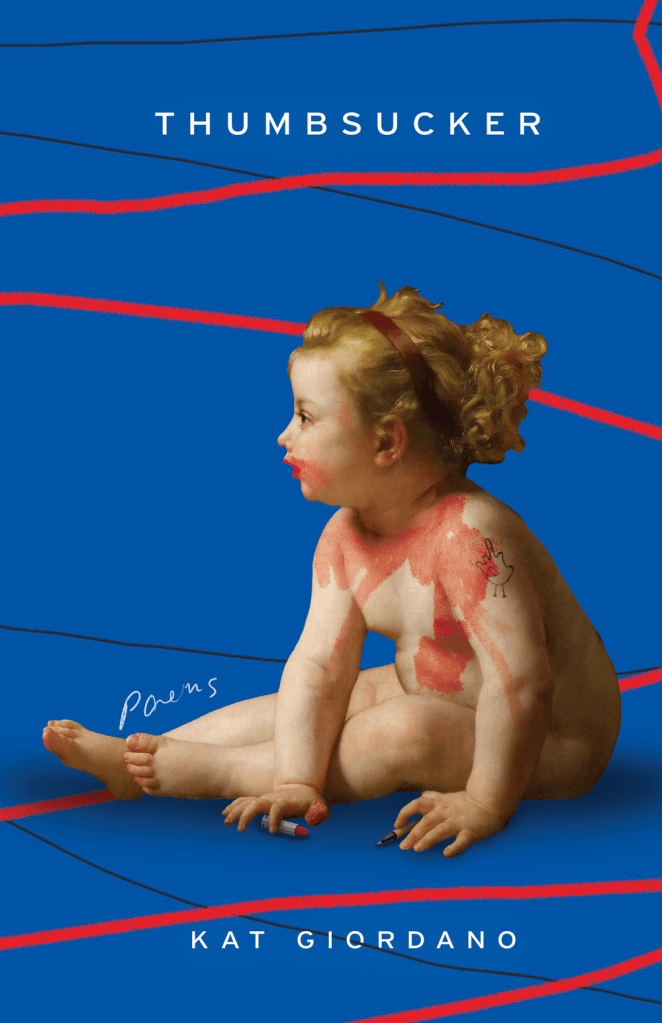
We talked about it. And many other things. It’s formatted as an interview. The kind with questions and answers. It looks like this:
Thumbsucker opens with the line “I don’t know what you people want.” Quite an antagonistic way to start a collection of poetry. Why do you hate your audience?
I don’t hate them.
No?
It’s a kind of half-endearing exasperation, like when I give a new stuffed toy to my dog (whom I would kill and/or die for but who is, inherently, due to being a dog, a little shit) and she immediately runs into the bedroom and destroys it and throws the stuffing all over the room and then I have to clean it up. You can’t really be mad or feel resentment, because they can’t help it. They’re doomed to go into a poetry collection, even one written by me (bless their hearts!), with a certain set of expectations, the way my dog is doomed to activate her otherwise deeply-repressed instinct to maim and kill small game whenever I hand her a stuffed animal to “play” with.
So, what you’re saying is that readers are little shits.
In fact, it’s difficult for me to imagine someone opening up a book of poetry and not needing to get their legs a little bit at first, so to speak. There’s so much baggage you have to shake off, even for the most well-read person, even in the best of circumstances, to just read and appreciate a poem for what it is and not project all of your expectations/hopes/fears about what poetry is (don’t ask me) or what you hope poetry might do for you (most likely nothing). With that in mind, it’s better to set the tone early. Rip the bandaid off.
I like this. A poetics built around reader’s and the poem’s discomfort and suspicion of the other.
There’s this poem I love by one of my favorite (and, in my opinion, not nearly widely-read enough) poets, Stephen Dunn, called “Poem For People That Are Understandably Too Busy To Read Poetry,” and it’s a lot less antagonistic than “Real Art,” the opener to Thumbsucker, but it assumes an audience that doesn’t know how they got there. One of my favorite passages, toward the end (but not the closing of the poem, which I won’t spoil) is as follows:
But don’t give anything for this poem.
It doesn’t expect much. It will never say more
than listening can explain.
Just keep it in your attache case
or in your house. And if you’re not asleep
by now, or bored beyond sense,
the poem wants you to laugh. Laugh at
yourself, laugh at this poem, at all poetry.
…and I guess I just think that’s a kickass way to meet poetry and to meet a reader: halfway, sure, but not without a little skepticism, or in my case hostility.
The title, Thumbsucker, evokes naivete, childishness, maybe even an unwillingness to grow up. Why does the past hold a grip on these poems?
The past holds a grip on these poems because of an overcorrection. A large part of my life has been spent trying to repress this part of me that wants to be adored and doted on and who feels entitled to some probably impossible level of unconditional love and care and consideration. But the thing is that denying the very human impulse to seek out these things doesn’t actually make you humble or more likely to attain them. It just makes you behave in ways that make you look like an asshole.
Is that the motivating factor in writing Thumbsucker—a need to be paid attention to? A need to be adored? A hostility?
All of the above.
A triple threat, then.
But it’s not so much that these things were a motivating factor in writing this collection specifically but that they’re a motivating factor to all of my writing. I think there’s a version of me in some other universe who felt seen and heard and understood enough, frequently enough, earlier in life and thus never developed this constant nagging impulse to share and be known and get attention, and if those impulses didn’t exist, I probably wouldn’t have written any book at all, let alone this one.
How do you approach putting a book together if the poems arise from similar places?
My approach to writing poetry collections thus far has basically been to just write a bunch of poems and then the throughline emerges later, once there are enough of them. And in this case, I ultimately found that the throughline was me grappling with this very concept, trying to be upfront about the need to be paid attention to and adored. I already see different themes emerging in the poetry I’ve written since, even if the impulse behind the writing of them is (largely) the same.
Some could say that this drive for attention and adoration is unhealthy. Sinful, even.
There are so many people who would be better off just admitting that they want more attention, that they’re angry that they’re not getting enough attention, that they’re bitter because the attention is going to someone who they think has suffered for it less or is otherwise less deserving. If you refuse to do this, if you reject these very normal, very human desires in favor of some cloying performance of humility, people sniff it out after a while. Because your inner child, that little baby who didn’t get enough emotional validation from mom and dad (for example…), is bored of the little corner of your mind where you’ve cuffed it to an exposed pipe and now it’s throwing handfuls of its shit all over the room.
Wait, that’s the premise of my Saw/Boss Baby crossover fanfic.
What were we talking about? Oh yeah, so I finally untethered my ugly, red-faced baby from the basement and now it’s throwing its shit all over the room. It has a lot to say and a lot of lost time to make up for. I just realized I worked so hard to express what is essentially just a shittier (literally) version of the “inner child” phenomenon that pop psychology has already been chewing on for a couple decades.
Tell me, what does your inner child see when they look at this?

An angry pig. See below:

Very interesting. And what is it about the unstoppable crawl of time that terrifies you?
I’m not answering that question, because I don’t think I should have to answer that question to someone who is older than me.
Not that much older. We’re basically the same age, really, in a geologic sense of time.
…
So, the book traffics in a confessional mode, both in the poetic tradition, but also in the Catholic sense. These poems create space where the speaker(s) are allowed to reveal and unburden themselves of their transgressions. What is it about this mode that you find appealing?
Hoooo boy I am grinning like a Cheshire cat right now, you have no idea. I’m going to answer this kind of methodically, in parts…
The book traffics in a confessional mode, both in the poetic tradition, but also in the Catholic sense.
[raised Roman Catholic voice] Those are separate things?
These poems create space where the speaker(s) are allowed to reveal and unburden themselves of their transgressions.
Reveal? Yes. Unburden? …Check back.
What is it about this mode that you find appealing, and why do you think it’s acceptable to implicate the reader in the sins of your poetry?
[raised Roman Catholic voi—] I’m a little bit of an exhibitionist.
Not just in the sense that I want to air my dirty laundry to the “masses” (the roughly 43 people who will actually read my poetry collection)—
Hold up. 43 readers? Those are rookie numbers. Let’s try to get that number up to 44. Who do you think needs to read this book and what will Thumbsucker do to kick their ass?
I don’t think you were asking me to name a specific person so much as “make up a guy,” but I’m going to name a specific person (or people) rather than make up a guy.
Yes! Kick their real, non-fictional ass, Kat!
A few years ago, I basically lost an entire group of friends at once during one of those breakups that feels like a bitter divorce.
Juicy. Go on.
A lot of the poetry in Thumbsucker (“Playing The Hits,” “Tracing The Hole,” “Friends,” “Bloodletting…,” “The Queen of Drag”—even the title poem alludes to some of those memories) is me trying to make sense of those relationships, the sudden loss of which fucked me up for a very long time and left me feeling like a marooned un-person without context. Having to re-learn how to get close to people again was not easy for me, and I was surprised by how difficult it was. After all, I’d been spoiled. I’d had one of those sitcom-type friend groups where you could just walk into someone’s apartment randomly and be welcomed with open arms, where you never had to “make plans,” because you always had some vague sense of what you were doing and who you were doing it with. It was such a magical, love-filled time in my life that felt like it ended abruptly, and too soon. And because we were all young and not emotionally available with each other unless we were drinking, I don’t feel like I ever truly expressed what they—and that time—meant to me.
So, if there were some way to get those people to read this collection, or at least those poems, and watch me struggle with those feelings but ultimately land at some kind of wistful reverence for everything that group of friends represented to me… well, I guess it wouldn’t improve their lives, but it would give some weird combination of vindication and closure. I guess it’s a self-serving exercise all the way down. I don’t think these people even think of me enough to “stalk” me online, but in case you’re here reading right now… well, read the damn book.
Sorry, I tuned out. Why do you want to implicate these readers in the sins of your poetry?
I want to let people in on the deeply humiliating process of trying to understand what the hell I am, abstractly, and whether I’m “doing this right.” It’s not (just) that I get a thrill out of letting the world in on my sexual proclivities and my gender angst and that weird dream I had one time about having a threesome at what appeared to be an adultified Scholastic book fair.
I think the Catholic Church would consider that a sin.
All of those tiny admissions are just incremental steps in some broader, more pathological endeavor to figure out what The Thing is—you know?
I do know. John Carpenter’s 1983 classic film The Thing starring Kurt Russell, Keith David, Walter Brimley, et al.
The Thing that I feel all the time, a gnawing, this breathing and mutating thing that I wish so badly I could open up a robe and expose like a questionable mole. The kind of thing you can biopsy and get a definitive answer about. And I know The Thing isn’t just one thing.
Well, no, it’s not one Thing. The Thing got a prequel in 2011 by Matthijs van Heijningen Jr. starring Mary Elizabeth Winstead, though, the original film was inspired 1951’s film The Thing from Another World, which was based on John W. Campbell’s novella Who Goes There. That’s at least, what, four Things?
I think I know deep down that The Thing can never actually be expressed or shown to anyone, but I have this gambler’s mind about it, you know? Like, sure, I’ll never be able to touch it, because it’s not something words can touch, but if I just draw another outline—an even tighter one this time—around everything in my life that is not The Thing, maybe it’ll reveal itself in the negative space. I know it won’t happen. I know it’s not possible. But I must. And it feels better when you watch. I don’t even care if you like it.
Let’s get real. What’s your least favorite poem in this collection?
“Questions,” hands-down.
Kick that poem’s ass, Kat!
I actually still love most of the stuff in here, authentically, which is impressive considering how many times I’ve had to read these poems over the last ~year or so and how many more, better poems I’ve written since this batch was locked in. But “Questions” bothers me in part because I think it’s one of the oldest ones in the collection and in part because I have never been 100% convinced it belonged in the collection but just left it in there for some reason. I think it could have easily been in Tell Me You’ve Earned It instead, given the subject matter. But because it wasn’t engaging with The End of a Relationship in that same like, unhinged ass way that the other poems in Tell Me did, I left it out, and it made it into this collection. Not to mention the fact that, in my opinion, the emotional conclusions it comes to are a little too “easy,” like it feels purely narrative rather than truly reflective or like it’s using the personal as a way to grasp at some more expansive (if still mostly personal) emotional truth. Sorry if this is somebody’s favorite poem in the collection, I guess, but I know it isn’t. If I were putting this book together again, it would be cut.
What’s your ideal experience when reading a poem? What do you want to get out of it?
I’ve sat on this question for a minute trying to find something less cliche to say, but unfortunately I am still stuck on the very vibeless answer of “I want it to make me feel something.” Which is so…you know.
We call that answer the poet’s cop-out.
But it’s true! I don’t read poetry for some utilitarian purpose, even in an emotional sense. I read poetry because it has, in my opinion, a unique capacity to illustrate how impotent language is in the face of the things that make us feel the most desperate to use it. So, I like when a poem about love ultimately demonstrates that writing a poem about love is like trying to slice through a loaf of bread like a toothpick. I like when a poem about grief ultimately demonstrates that there’s nothing you can say about grief, because if you could just say it, then you wouldn’t be writing the poem. Like the best poems exist because they are impossible, and they often are written out of some delusional optimism that this time, it will be possible, that it will serve the purpose it needs to serve, that you’ll be able to say the thing you need to say, only to fall short again and then persist as, like a monument to that falling-short. That’s how writing a good poem feels to me, too, so I guess it’s really the same experience. You start out convinced you’re going to really say The Thing this time, and of course you don’t, because you can’t, because nobody can, but by the end you don’t care anyway.
Purchase a copy of Thumbsucker here.
Kat Giordano was born in Philadelphia and it’s been downhill ever since. Their most recent poetry collection Thumbsucker came out in April with Malarkey Books. They tweet at @giordkat. Kat is very cool. You like them.
 kicking your ass